
Ohio Death Records
Ohio death records are held at the county and state level. You can search for death certificates through the local health department where the death took place, or through the Ohio Department of Health in Columbus. The state has 88 counties, and each one has a health department that keeps its own death records going back to December 1908. If you need a certified copy, you can order one in person, by mail, or online through services like VitalChek. Ohio is an open records state, so anyone can request a copy with basic facts about the person who died. The Ohio History Connection holds older death records from 1908 through 1970, which helps if you are doing genealogy work or need a record from decades past.
Ohio Death Records Overview
Where to Find Ohio Death Records
Ohio death records sit in two main places. The county health department holds death certificates for deaths that happened in that county. The Ohio Department of Health keeps a statewide file of death records from 1954 to the present. Both can give you a certified copy. The state charges $21.50 per copy as of January 2025, plus a $5.00 fee that goes toward updating the vital records system. County fees vary but most charge between $22.00 and $32.00.
Death records filed before 1954 take a bit more work to find. The Ohio Department of Health has records going back to 1954. For death records from December 20, 1908 through 1953, the Ohio History Connection is where you look. They hold the state's older vital records at their archives in Columbus. Records from before 1908 are kept at the county probate court. Each county had its own system of recording deaths between 1867 and 1908, so the quality and detail of those early records can vary quite a bit from one county to the next.
The screenshot below shows the Ohio Department of Health vital statistics portal where you can start your search for Ohio death records.
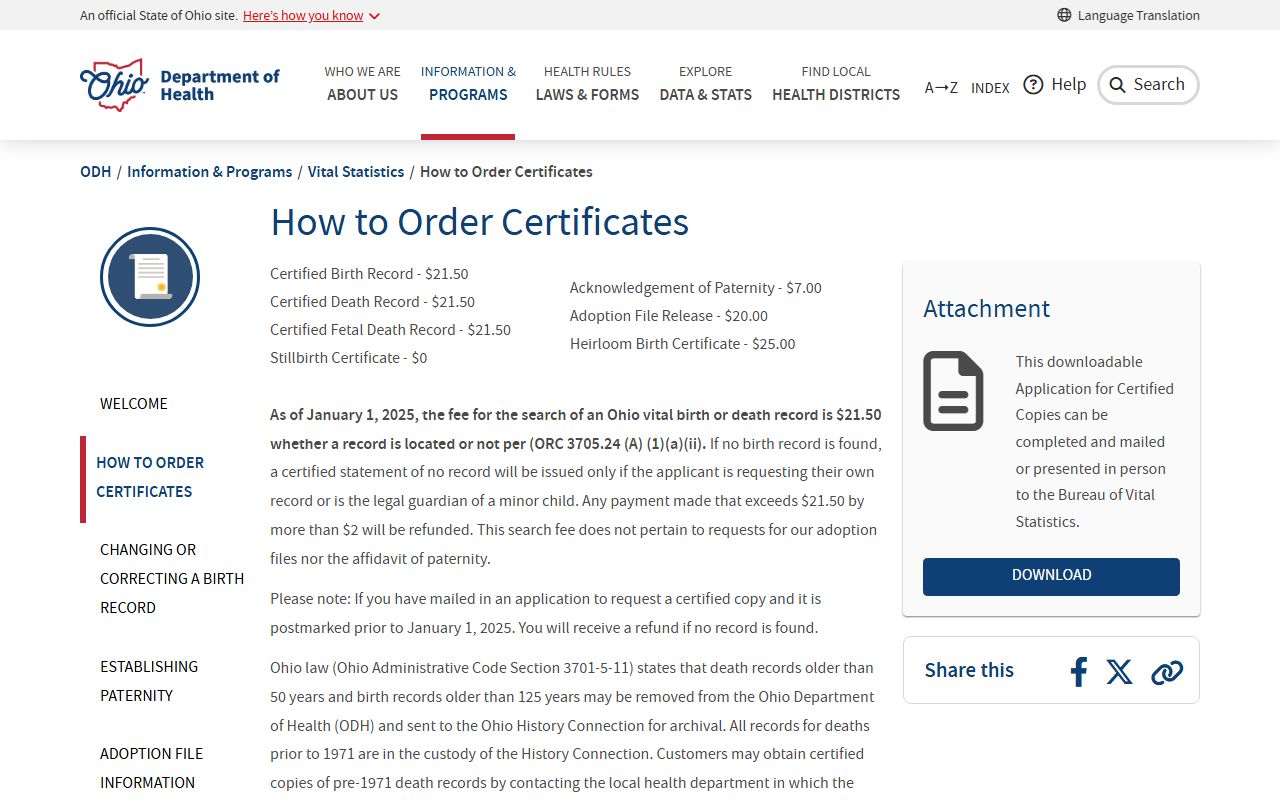
The ODH portal provides ordering options and details on how to get certified copies of death certificates from anywhere in Ohio.
Note: Ohio death certificates are public records under Ohio Revised Code Section 149.43, but the social security number is redacted for the first five years after death unless you are an authorized requestor.
How to Search Death Records in Ohio
There are a few ways to search for Ohio death records. The method you pick depends on how old the record is and how fast you need it.
For recent death records, contact the health department in the county where the person died. Walk in during business hours and staff can look up the record while you wait. Most county offices are open Monday through Friday from 8:00 AM to 4:00 PM. You need the full name of the person who died and the approximate date of death. Having the parents' names also helps narrow things down. Many Ohio counties now let you order copies online through VitalChek or Permitium, which adds a processing fee on top of the base cost but saves you a trip. The Ohio Department of Health ordering page walks you through the state-level process step by step.
To request Ohio death records by mail, you send a completed application with your payment to either the county health department or the Ohio Department of Health at 4200 Surface Road, Columbus, OH 43228. Include a check or money order. Mail requests usually take one to two weeks. In-person requests at the county office are often done the same day.
The Ohio History Connection page shown below is where you can look for older death records dating back to 1908.
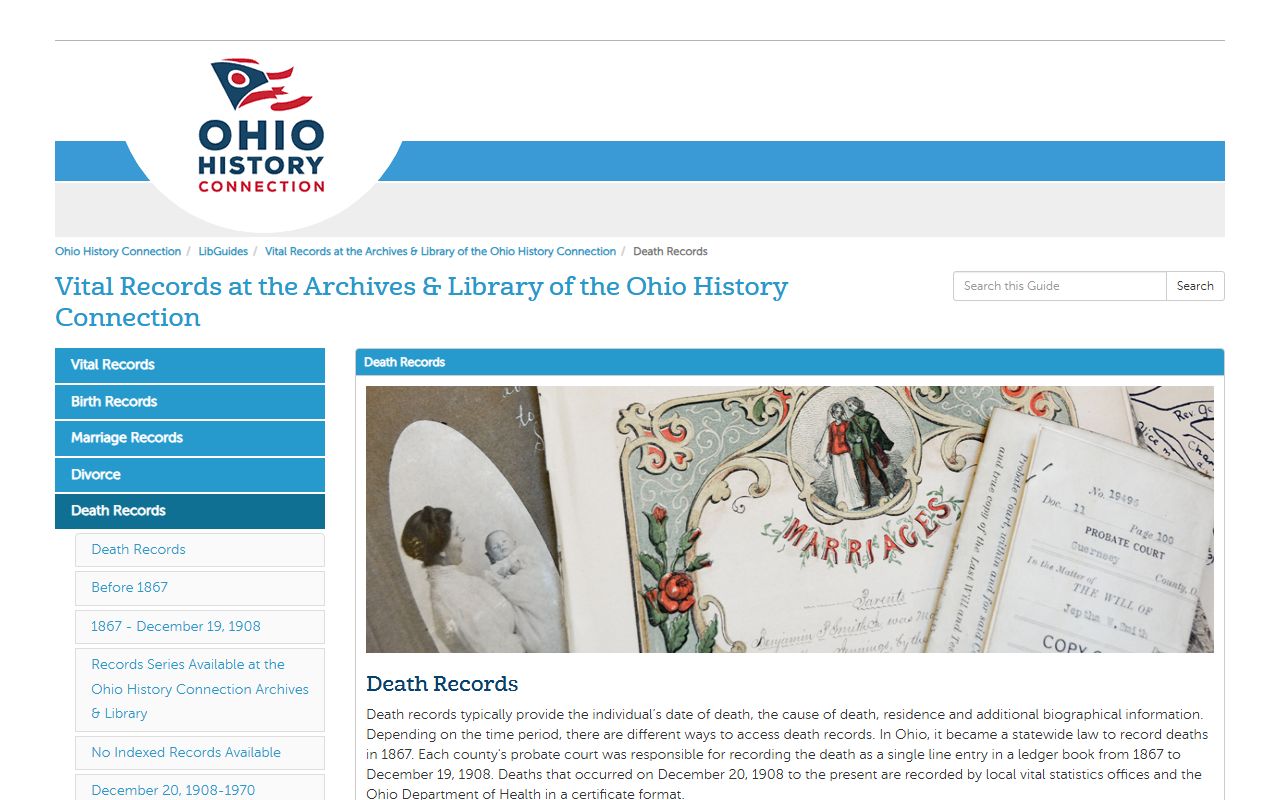
This resource is particularly useful for genealogy searches and finding historical Ohio death records that are no longer held at the state health department.
What Ohio Death Certificates Show
An Ohio death certificate has a lot of information. Under Ohio Revised Code Section 3705.16, each death in the state must be registered with the local registrar. The funeral director collects the personal details and files the certificate. A doctor or coroner fills in the medical part.
A certified copy of an Ohio death certificate shows the full name of the person who died, their date of birth, the date and place of death, cause of death, the attending physician or coroner who certified it, and information about burial or cremation. It also lists the parents' names, the decedent's social security number (though this gets redacted for the first five years under Section 3705.23 unless you are an authorized person), marital status, and usual residence. The medical certification must be completed and signed within 48 hours after the physician or coroner is told about the death.
Ohio death records serve many purposes. People use them to settle estates, file insurance claims, close bank accounts, and handle property transfers. You may also need one to prove a family connection for genealogy work. The certificate is considered prima facie evidence of the facts it contains, meaning courts and other agencies accept it at face value.
Ohio Death Records Laws
Ohio Revised Code Chapter 3705 covers the state's vital statistics system, including death records. The law sets out who files a death certificate, what it must contain, and who can get copies. Section 3705.01 defines "vital records" as certificates of birth, death, fetal death, marriage, and divorce, along with all related data. This section also defines key terms like "dead body," "attending physician," and "final disposition."
The image below shows the Ohio Revised Code sections that cover death records and vital statistics.
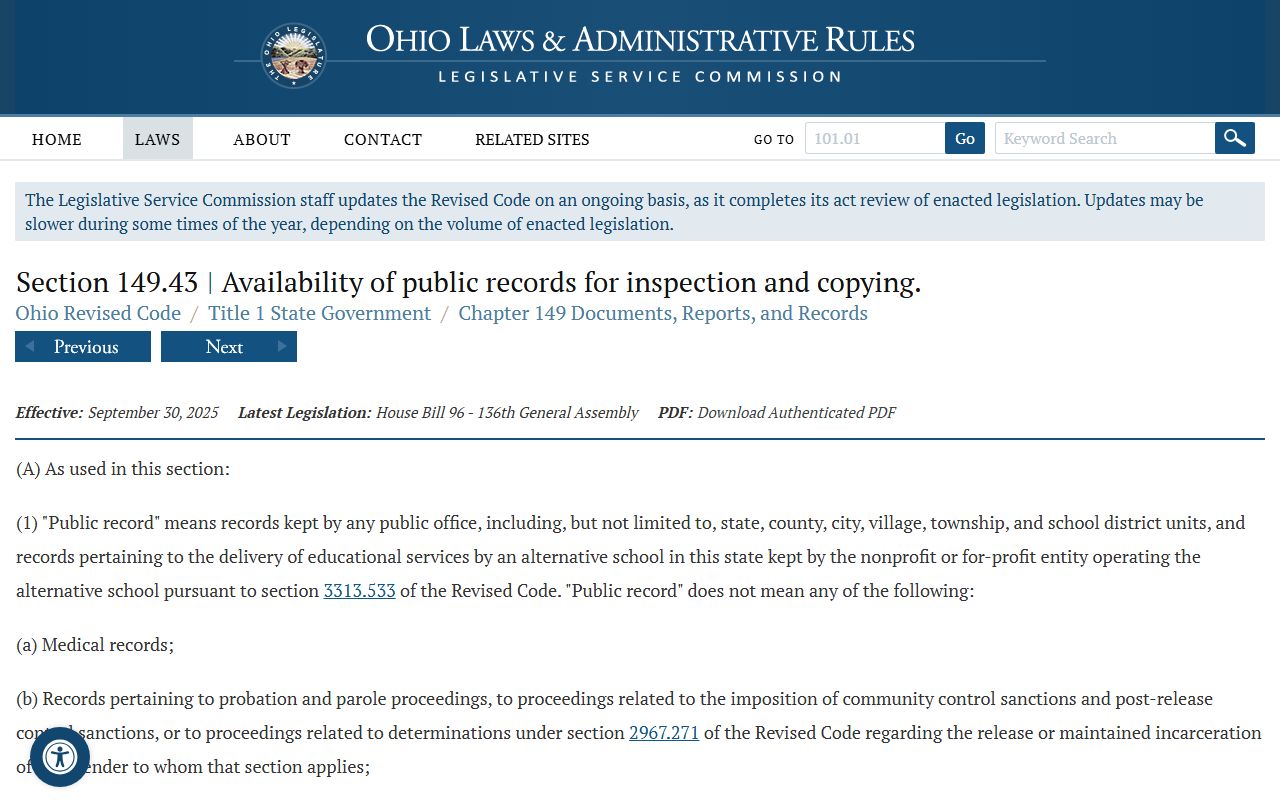
These statutes form the legal basis for how death certificates are filed, stored, and released in Ohio.
Section 3705.24 sets the fee rules. The law says certified copy fees cannot be less than $12.00. As of 2025, the actual fee at the state level is $21.50 plus a $5.00 modernization surcharge. County health departments set their own fees on top of this, which is why you see costs ranging from $22.00 to $32.00 across Ohio's 88 counties. Four dollars of each fee goes to the state office of vital statistics quarterly, and another dollar goes toward subsidies for local health departments.
Section 3705.07 spells out what local registrars must do. They number each death certificate, sign it, make a copy for local records, and send the original to the state. If a death was caused by a communicable disease, the registrar must tell the health commissioner right away. The state office of vital statistics keeps a permanent index of all deaths and checks each record for completeness.
Falsifying a death certificate is a crime in Ohio. Section 3705.29 makes it illegal to make false statements on vital records, counterfeit or alter certificates, or possess stolen records. Only a coroner or medical examiner can certify a death that happened under circumstances that were not natural, such as violent, suspicious, or sudden deaths.
Death Records and Burial Permits
Ohio ties death records to the burial permit process. Under Section 3705.17, no one can bury, cremate, or otherwise dispose of a body until the local registrar issues a burial permit. The permit costs $10.00. Most of that fee goes into the cemetery registration fund. The fee is waived when a government agency is paying for the burial.
A burial permit cannot be issued until a death certificate is on file. If the doctor has not yet completed the medical certification, the funeral director can file a provisional death certificate. But a provisional certificate does not allow cremation. The full certificate must be filed within five days. Cemeteries and crematories must keep burial permits for at least five years and record the name of the deceased, the date of burial or cremation, and the funeral director's name and address. These records are open to public inspection.
Are Ohio Death Records Public
Yes. Ohio is an open records state. Death certificates are public records under Section 149.43 of the Ohio Revised Code. Anyone can request a copy. You do not need to be a family member. You do not need to give a reason for your request. The public office must make the record available promptly during regular business hours.
There is one main restriction. For the first five years after a death, the social security number on the death certificate is hidden unless you are an authorized requestor. The law lists who qualifies: the spouse, lineal descendants, government officials, licensed private investigators, attorneys, funeral directors, and a few other groups spelled out in Section 3705.23. After five years, the full record including the social security number is available to anyone.
If a public office refuses your request or redacts information, they must explain why and cite the legal authority. You can file a complaint if you believe your request was wrongly denied. The law gives the public office three business days to fix the problem after receiving a complaint.
Order Ohio Death Records Online
VitalChek is an authorized online service for ordering Ohio death certificates. Many county health departments in Ohio partner with VitalChek to let people order certified copies from home. The base certificate fee goes to the county, and VitalChek adds a processing fee on top. Some counties use Permitium instead, which works the same way.
The image below shows the VitalChek portal for ordering Ohio vital records including death certificates.

VitalChek offers expedited processing for an extra charge, and you can pay by credit or debit card, which many county offices do not accept for mail orders.
To order through VitalChek, you need the full name of the deceased, the date of death, and the county where the death happened. Processing times vary. Standard orders usually ship within five to seven business days. Rush orders can arrive faster but cost more. Not every Ohio county uses VitalChek, so check with the local health department first if you want to order online.
Browse Ohio Death Records by County
All 88 Ohio counties have a health department that issues death certificates. Pick a county below to find the local office, fees, and ordering details for death records in that area.
Death Records in Major Ohio Cities
Residents of Ohio's largest cities get death certificates through the health department in their county. Pick a city below to find out where to go for death records.